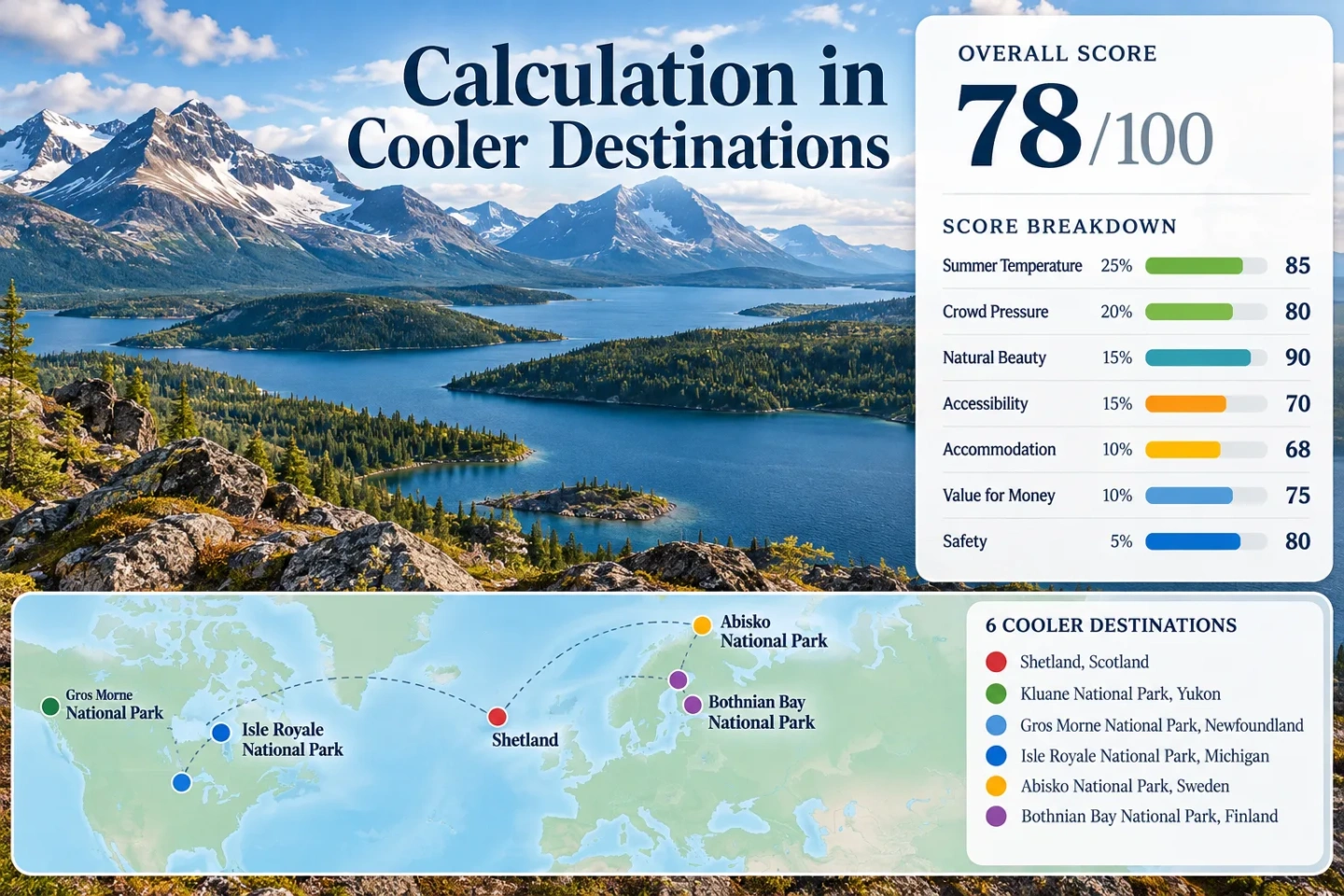
Cooler Summer Destinations With Lower Crowd Pressure
A cooler summer does not have to mean trading heat for another kind of pressure. Northern islands, subarctic mountain parks, maritime national parks and lightly visited lake districts can combine milder daytime conditions with lower visitor concentration than major summer resort corridors. The strongest choices are places where cooling geography and lower visitor volume overlap, while transport limits, short operating seasons and localized peak periods remain part of the planning equation.
Northern island, lake, mountain and maritime destinations with documented low or comparatively lower visitor pressure.
Conditions are evaluated around Northern Hemisphere summer travel rather than assuming one identical peak week.
Lerwick’s 1991–2020 average July maximum is 14.4°C, with an average minimum of 10.1°C.
Bothnian Bay National Park appears at 6,300 visits in Finland’s 2025 table; Metsähallitus notes that its 2024 figure was carried forward because updated data were unavailable.
Low annual visitation is considered together with ferries, campsites, harbours, permits and other bottlenecks that can still concentrate visitors.
Where Cooler Weather and Lower Pressure Overlap
Annual visitor totals alone do not determine how quiet a place feels. A remote island with 30,000 annual visits can still have crowded ferry departures, while a larger park can disperse visitors across roads, communities and trail systems. The more useful comparison combines summer climate, documented visitation, transport friction and local capacity.
| Destination | Summer Cooling Signal | Crowd-Pressure Evidence | Main Access Trade-Off | Pressure Pattern |
|---|---|---|---|---|
| Shetland, Scotland | Lerwick July normal: 14.4°C max / 10.1°C min | 89,000 visits in the 2024 island survey, excluding cruise visitors | Flight or ferry access | Low overall volume, with cruise-day concentration around Lerwick and major sights |
| Kluane National Park and Reserve, Yukon | Haines Junction July normal: 20.3°C max / 6.3°C min | Parks Canada identifies Kluane as a less-busy alternative and reports fewer than 40,000 annual visitors | 160 km west of Whitehorse; much of the interior has specialist access | Low regional pressure with localized campground and trail demand |
| Gros Morne National Park, Newfoundland | Nearby Daniel’s Harbour July normal: 17.9°C max / 11.3°C min | Parks Canada includes Gros Morne among less-busy alternatives to heavily visited parks | Regional road trip or Deer Lake airport connection | Visitors spread among multiple coastal communities and trail areas |
| Isle Royale National Park, Michigan | Cold Lake Superior moderates the island relative to the mainland | 29,091 recreation visits in 2025 visitor-use data | Passenger ferry, seaplane or private boat only | Very low annual visitation, but docks and campgrounds can tighten in July–September |
| Kolovesi National Park, Finland | Forest, lake water and eastern Finnish latitude limit persistent urban-style heat exposure | 16,700 visits in 2025 | Paddling-oriented park with extensive motorboat restrictions | Low annual volume, although tent sites become difficult to secure in July–August |
| Bothnian Bay National Park, Finland | Northern latitude plus exposed Gulf of Bothnia marine air | 6,300 visits in the published 2025 table, using the previous year’s figure | National park islands are accessible only by boat in summer | Extremely light visitation at park scale, with access itself limiting numbers |
Shetland: Maritime Air Without Mainland Summer Heat
Lerwick’s Narrow Summer Temperature Range
Shetland has one of the clearest climate cases in the comparison. At Lerwick, the UK Met Office 1991–2020 normal gives an average maximum of 12.6°C in June, 14.4°C in July and 14.7°C in August. Average July nights are about 10.1°C.
The trade-off is maritime exposure rather than heat. July averages about 12 days with at least 1 mm of rain at Lerwick, while wind remains a normal part of island conditions. Travelers seeking reliably warm swimming weather are likely to find the climate too cool; travelers prioritizing walking temperatures and sleep-friendly nights have a much stronger match.
Climate source: Met Office Lerwick 1991–2020 climate averages.
Low Island Volume With a Cruise-Day Exception
VisitScotland’s 2024 Shetland Visitor Survey estimated 89,000 visits. That is a modest annual visitor volume for an entire island group, but the survey explicitly excludes cruise visitors. The number therefore should not be interpreted as the total number of people stepping ashore during the year.
Lerwick, Sumburgh Head, St Ninian’s Isle and other high-recognition locations can feel different when a cruise ship is in port. Staying several nights and moving beyond the main excursion circuit produces a different pressure profile from a short port call.
Visitor source: VisitScotland Shetland research and 2024 visitor figures.
Kluane: Cool Nights and Very Low Visitor Volume
Haines Junction Keeps a Strong Night-Cooling Advantage
Environment and Climate Change Canada’s 1991–2020 normals for Haines Junction show an average July maximum of 20.3°C and an average minimum of 6.3°C. June averages 18.8°C by day and 4.1°C at night.
That large day-night range matters. Warm afternoons can occur, but overnight conditions usually reset much more strongly than in many low-elevation continental summer destinations.
Fewer Than 40,000 Visitors Is a Different Scale
Parks Canada specifically presents Kluane as a lower-traffic alternative to heavily visited mountain parks and states that fewer than 40,000 people visit yearly. The comparison is especially striking against Canadian Rockies parks receiving visitor totals in the millions.
Low annual volume does not remove all concentration. Kathleen Lake, roadside trailheads and the Haines Junction visitor area absorb a larger share of front-country use because enormous sections of the park are not conventional drive-up sightseeing terrain.
The Same Friction That Reduces Crowds Complicates a Trip
Haines Junction is about 160 km west of Whitehorse. Highways provide access along the park’s eastern side, but Parks Canada notes that much of the interior is generally reached through flightseeing or serious wilderness and mountaineering travel.
Overnight backcountry travel from April through mid-November requires registration and permits under current park rules. Kluane is therefore a strong fit for travelers willing to trade resort convenience for space, large landscapes and colder nights.
Gros Morne: A Cooler Atlantic Alternative With Road Access
Newfoundland’s West Coast Stays Mild Near the Sea
Daniel’s Harbour, north of Gros Morne on Newfoundland’s west coast, provides a useful official maritime reference. Its 1991–2020 July normal is 17.9°C for the daily maximum and 11.3°C for the daily minimum. August averages 18.8°C by day and 12.2°C at night.
Weather inside Gros Morne varies substantially with elevation, wind exposure and distance from the coast. The representative station should therefore be treated as a coastal benchmark rather than a temperature guarantee for every trail.
Several Coastal Bases Help Distribute Overnight Demand
Parks Canada identifies Gros Morne as one of its less-busy alternatives to heavily visited national parks. Unlike an isolated trailhead destination, overnight demand can be spread among Cow Head, Norris Point, Rocky Harbour, Trout River, Woody Point and other surrounding communities.
Access is easier than at Kluane or Isle Royale. Gros Morne is about 30 minutes from Deer Lake airport, while the Port aux Basques ferry terminal is roughly four hours away by road. That accessibility raises visitor numbers compared with very remote wilderness parks, but it also allows travelers to avoid putting every night into one small accommodation node.
Isle Royale: Lake Superior Cooling With an Access Bottleneck
Low Annual Visitation Does Not Mean Empty Campsites
Isle Royale recorded 29,091 recreation visits in 2025 in National Park Service visitor-use data, placing it among the least-visited U.S. national parks. The island’s isolation is a major part of that number: visitors cannot drive there.
However, the National Park Service warns that docks and campgrounds can experience crowded conditions from July through September. Isle Royale demonstrates an important distinction between low total visitation and low pressure at every individual facility.
Cold Water Suppresses the Island’s Summer Heat
The National Park Service notes that Isle Royale is kept cooler than the surrounding mainland by the cold waters of Lake Superior. May and June tend to be cold and foggy, July often has the calmest lake conditions, and August brings the warmest water.
Access is the limiting factor. Public arrivals are by ferry or seaplane, while vehicles remain on the mainland. The Ranger III’s 2026 Houghton–Rock Harbor service generally ran only on Tuesdays and Fridays, with the crossing taking about six hours. Transportation reservations are strongly recommended.
Isle Royale transportation information · National Park Service climate context
Finland’s Low-Volume Water Parks: Kolovesi and the Bothnian Bay
Two Finnish national parks show how low visitor numbers can arise from very different kinds of friction. Kolovesi is a forest-and-lake paddling landscape in eastern Finland. Bothnian Bay National Park is a northern marine archipelago that has no road connection at all.
Kolovesi Has Only 16,700 Annual Visits, but July Still Matters
Metsähallitus recorded 16,700 visits to Kolovesi National Park in 2025. The park’s structure also suppresses motorized visitor circulation: using motorboats and similar craft is prohibited across designated waters, with internal-combustion boats excluded from nearly all of the national park to protect the Saimaa ringed seal.
The low annual count should not be converted into an assumption that every campsite will be available. Park authorities identify July and August as the peak period and explicitly warn that finding a tent site can be difficult. They recommend the first weeks of June or the final weeks of August for lower pressure.
Cooling character: Forest shade and extensive lake water can soften the feel of summer, but eastern Finland can still receive hot spells. Kolovesi is better treated as a lower-pressure lake escape than as a guaranteed cold-weather destination.
Kolovesi peak-season and access rules · Metsähallitus 2025 visitation figures
Bothnian Bay Pushes Visitor Pressure Down Through Geography
Bothnian Bay National Park consists of outer-archipelago islands and skerries off Kemi and Tornio. The park can only be reached by boat during the summer. There is no regular public transport to most of the islands, and personal watercraft or commercial transport arrangements are generally required.
The national visitation table lists 6,300 visits. Metsähallitus separately notes that updated 2025 figures were unavailable for Bothnian Bay National Park, so the published 2025 table carries forward the 2024 count. That limitation matters when comparing exact years.
The cooling logic comes from northern latitude and exposure to the Gulf of Bothnia rather than elevation. Summer heat is still possible in Finland, but exposed islands, open water and long northern evenings create a different heat profile from inland urban areas.
Bothnian Bay National Park access information · Metsähallitus visitation data status
Lower Annual Crowds Can Still Produce Local Bottlenecks
Ferries Can Become the Real Reservation Problem
Island destinations often reduce total visitor numbers through access friction, but the remaining demand is forced through a limited number of departures. Isle Royale is the clearest example: low annual visitation coexists with limited ferry schedules and advance-reservation advice.
Shetland has more transport capacity, yet ferry cabins, rental cars and accommodation can still tighten around summer dates. Low crowd pressure on the landscape does not guarantee last-minute transport.
Small Campsites Can Fill Before a Region Feels Busy
Kolovesi illustrates how a park with fewer than 20,000 annual visits can still experience campsite pressure in July and August. Isle Royale makes the same point through its warnings about summer docks and campgrounds.
Camping capacity is therefore a separate variable from total destination visitation. A low visitor count spread over hotels and roads behaves differently from the same count concentrated into a handful of tent sites and boat landings.
One Famous Stop Can Distort the Experience
Lower-pressure regions still contain high-recognition viewpoints and day-trip nodes. Cruise calls can concentrate visitors in central Lerwick. Kluane’s accessible front-country areas absorb a greater share of visitors because its vast interior remains difficult to reach.
Planning implication: Regional quiet is more useful when accommodation and daily activities are spread across several bases rather than centered on the single most photographed location.
How Much Access Friction Is Worth the Extra Space?
| Travel Preference | Stronger Match | Why It Fits | Main Compromise |
|---|---|---|---|
| Very cool daytime weather without wilderness logistics | Shetland | Lerwick’s July maximum normal is only 14.4°C and settlements retain normal visitor services | Wind, rain and cruise-day concentration |
| Mountain scenery with unusually low visitor volume | Kluane | Fewer than 40,000 annual visitors and strong overnight cooling at Haines Junction | Long distances and restricted interior access |
| Cool Atlantic hiking with straightforward road access | Gros Morne | Maritime temperatures plus multiple surrounding accommodation communities | More visitor activity than the highly remote selections |
| Maximum separation from road-trip crowds | Isle Royale | No vehicle access and only about 29,000 recreation visits in 2025 | Ferry or seaplane planning and localized campsite pressure |
| Quiet paddling and forest-lake travel | Kolovesi | 16,700 annual visits and extensive motorboat restrictions | July–August tent sites can become constrained |
| Extremely light-use northern marine islands | Bothnian Bay | Very low published visitation and boat-only park access | Limited public transport and dependence on marine conditions |
June and Late August Often Change the Crowd Equation
Lower-pressure destinations still have their own compressed high seasons. The most useful timing adjustment is often not abandoning summer altogether, but moving away from the narrow period when weather, school holidays and transport schedules align.
June Favors Space but Demands More Weather Flexibility
Shetland remains distinctly cool in June, with Lerwick’s average maximum at 12.6°C. Kolovesi authorities specifically point to the first weeks of June as a quieter period.
Farther north and at higher elevations, early summer can also mean colder water, lingering snow, wet ground or incomplete trail access. Gros Morne, for example, closes the mountain summit area during part of May and June for wildlife protection before summer access resumes.
July Brings the Strongest Access and the Most Concentration
July normally offers the broadest visitor-service window, but that same reliability concentrates demand. Kolovesi identifies July–August as its peak period, while Isle Royale’s ferry, dock and campground system carries much of its annual traffic during the short open season.
Kluane retains a stronger low-pressure advantage even in midsummer because the destination operates on a much smaller visitor scale.
Late August Can Improve the Pressure-to-Weather Balance
Late August is particularly useful at Kolovesi, where park authorities recommend the final weeks of the month as an alternative to the main peak. Isle Royale also begins moving toward lower insect pressure later in the season, although transportation and weather become increasingly important planning variables.
At maritime destinations such as Shetland, August remains climatically mild rather than hot: Lerwick’s 1991–2020 average maximum is 14.7°C.
A Lower-Pressure Summer Usually Requires One Extra Trade-Off
The destinations with the clearest combination of cooler conditions and lower visitor pressure rarely offer the frictionless logistics of major resort corridors. Shetland exchanges heat for wind and ferry or flight planning. Kluane exchanges mass tourism for distance. Isle Royale exchanges road access for boat capacity. Kolovesi and the Bothnian Bay exchange high-volume infrastructure for water-based movement.
That trade can be worthwhile when the objective is not simply a lower thermometer reading, but a summer trip with more physical space. The most reliable strategy is to compare climate and crowd evidence separately, then check the bottleneck that annual visitor statistics do not show: accommodation inventory, ferry seats, campsites, harbour space or the small number of accessible trailheads.