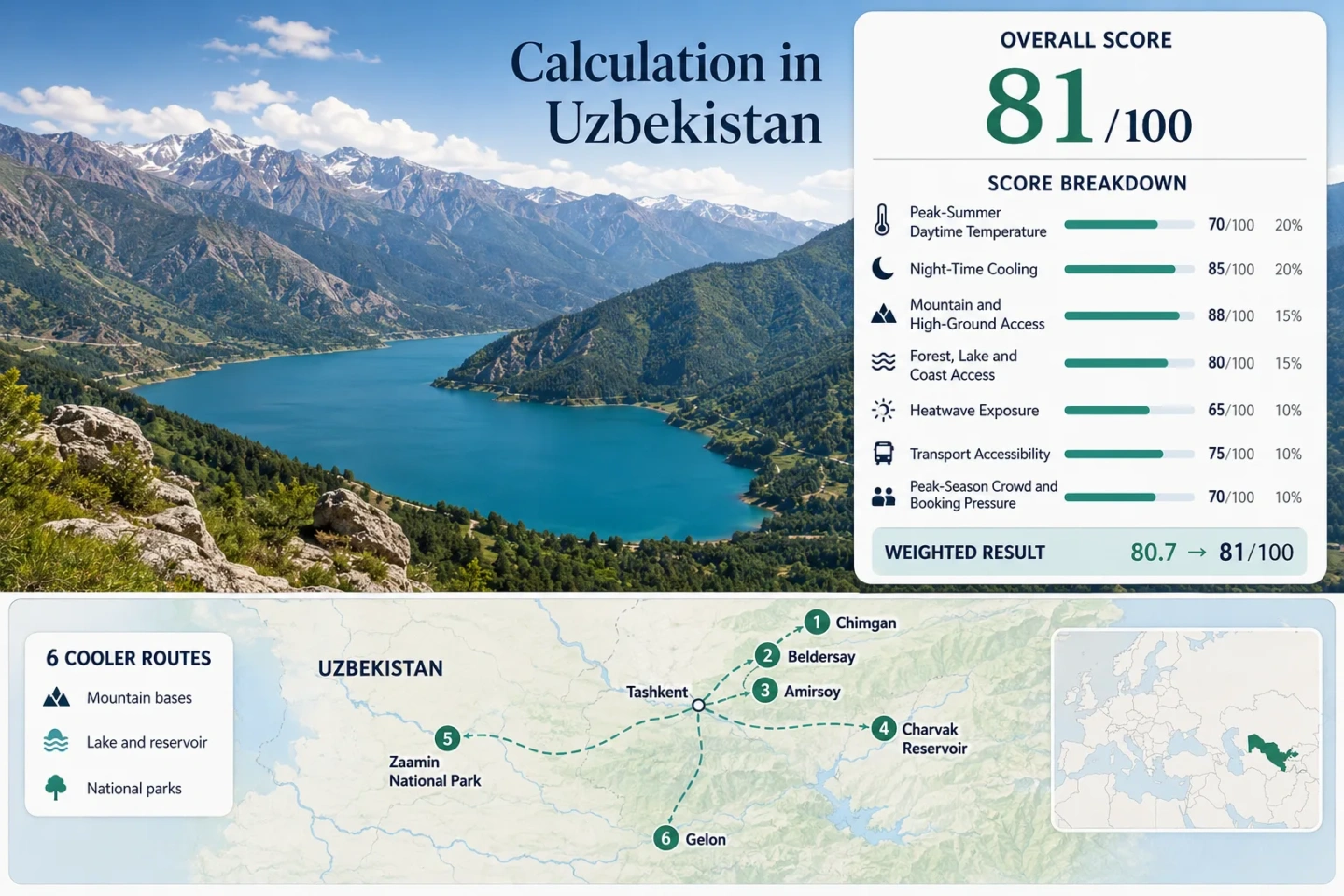
Uzbekistan Beyond the Summer Heat: Chimgan Peaks, Charvak Water and Highland Retreats
Uzbekistan’s most useful summer relief is concentrated in elevated valleys, Western Tien Shan resort areas and southern mountain villages rather than the country’s lowland heritage cities. Chimgan, Beldersay and Amirsoy offer fast altitude gain from Tashkent, Charvak adds swimming and evening water access, while Zaamin and Gelon trade shorter transfers for higher sleeping elevations and cooler nights.
The score, map and route comparisons use the same six destinations without adding points for route quantity.
The July–August route median favors high sleeping bases even when exposed valleys become hot during the afternoon.
Three mountain bases sit within the same Bostanlyk corridor, roughly 65–80 km from Tashkent.
The reservoir has the strongest swimming access in the set but also the warmest daytime and night-time temperature profile.
Longer road transfers reach mountain accommodation zones where night cooling matters more than resort infrastructure.
Charvak shores and the Bostanlyk resort corridor receive concentrated weekend traffic from Tashkent.
Western Tien Shan, Charvak and Southern Highland Planning Points
The northern cluster supports shorter mountain breaks from Tashkent, while Zaamin and Gelon require longer regional transfers. The numbered markers correspond directly with the route cards.
This marker map is built for planning orientation. Marker positions use approximate public location centers rather than guaranteed viewpoints, trailheads, legal parking areas or accommodation entrances. Use the named Google Maps links and current local access information before traveling.
Uzbekistan Highland and Reservoir Cooler Escape Suitability Score
This transparent editorial suitability index uses disclosed climate, landscape, access and capacity factors. It is not an official climate classification, safety rating or weather forecast. Climate values use a consistent route-center reanalysis framework, but steep elevation changes and limited direct highland stations reduce local comparability.
Weighted total: 67×0.25 + 100×0.20 + 100×0.15 + 75×0.15 + 93×0.10 + 60×0.10 + 50×0.05 = 80.8 → 81/100
Method: Route quantity does not add bonus points. Each route carries equal weight inside a factor, route-level values are combined using the median, and the seven fixed factor weights are then applied.
Chimgan Slopes, Charvak Water and High-Altitude Village Bases
The route set separates three different summer strategies: rapid altitude gain from Tashkent, water-centered days around Charvak, and longer transfers to higher southern or eastern sleeping bases.
Chimgan
Chimgan is the most flexible mountain base in the northern cluster. The route-center climate proxy produces a July–August daytime mean maximum near 27.0°C and a night minimum near 14.0°C. The published Chimgan weather-station area sits around 1,670 m, while Small Chimgan reaches 2,097 m and Greater Chimgan rises to 3,309 m.
Accommodation, local road transfers and multiple walking options make Chimgan easier to use without committing to a single resort complex. Early hiking remains important because open slopes can still become hot and exposed by midday.
Beldersay
Beldersay lies about 80 km from Tashkent and roughly 5 km from the Chimgan tourist base. Its published cableway system includes a 565 m height difference, creating a practical way to gain elevation when summer operations are running.
The route-center proxy places average July–August daytime maxima near 25.8°C and minimum temperatures near 12.9°C. A river valley, gorge terrain and higher lift-served slopes create a stronger daytime cooling pattern than Charvak’s lower shoreline.
Amirsoy
Approximately 65 km from Tashkent, Amirsoy is the most infrastructure-led mountain option in the set. The resort’s gondola, chairlift, maintained roads and organized services reduce the logistical uncertainty found on more independent highland routes.
A July–August proxy of about 25.2°C by day and 12.5°C at night supports noticeably cooler sleeping conditions than Tashkent or the Charvak shoreline. The advantage depends on remaining at the elevated resort rather than returning to the lowlands each evening.
Good for: Travelers prioritizing structured accommodation, managed access and a shorter transfer from the capital.
Charvak Reservoir
Charvak solves a different problem from the mountain resorts. It provides reservoir access, evening shoreline activity and a water-centered break, but its lower planning zone has the warmest proxy values in the route set: about 31.9°C for July–August daytime maxima and 18.4°C for nights.
Swimming hours and mountain-walking hours should be separated. Early mornings can be used for nearby slopes or viewpoints, while water access becomes the stronger reason to remain near the reservoir later in the day.
Zaamin National Park
Zaamin shifts the emphasis from resort lifts to juniper forest, protected mountain terrain and sanatorium-style highland stays. The elevated visitor zone reaches approximately 2,000 m, while the route-center proxy gives a July–August daytime maximum near 24.6°C and a minimum near 12.2°C.
The park is not interchangeable with lower Zaamin town. Accommodation elevation, permit requirements and the exact park access point materially affect summer comfort and journey time.
Gelon
Gelon is the route for travelers willing to exchange short transfers for a high-altitude village base in Kashkadarya. The surrounding Hissar reserve system spans roughly 1,750–4,349 m, and official information places the wider reserve 170–200 km from Karshi.
The route-center proxy indicates about 25.8°C for July–August daytime maxima and 11.5°C for nights. Guesthouse coordination, driver timing and road conditions are more important here than lift schedules or resort transport.
Gelon has been accessible to international visitors since 2018, while current government plans describe a much larger all-season resort. Existing village capacity and future resort capacity should not be treated as the same supply.
Six Routes, Six Different Heat-Management Strategies
The lowest daytime temperature, easiest transfer and strongest water access do not occur in the same place. The primary comparison retains every route used by the map and score.
| Route | July–August Day Proxy | Night Proxy | Main Cooling Mechanism | Access Pattern | Capacity Watch |
|---|---|---|---|---|---|
| Chimgan | 27.0°C | 14.0°C | High sleeping base, gorges and rapid access to higher slopes | Road transfer from Tashkent | Weekend recreation traffic |
| Beldersay | 25.8°C | 12.9°C | River gorge and lift-assisted elevation gain | Road transfer; summer lift schedule matters | Concentrated operating-day demand |
| Amirsoy | 25.2°C | 12.5°C | Elevated resort base and managed lift infrastructure | Approximately 65 km from Tashkent by road | Resort rooms, lifts and parking |
| Charvak Reservoir | 31.9°C | 18.4°C | Swimming and evening water access rather than low daytime heat | Multiple shoreline settlements and access roads | Strongest weekend shoreline pressure |
| Zaamin National Park | 24.6°C | 12.2°C | Juniper forest and accommodation near the 2,000 m zone | Regional transfer plus final park road | Permit and accommodation planning |
| Gelon | 25.8°C | 11.5°C | High village nights and Hissar mountain exposure | Long arranged road transfer | Limited existing guesthouse supply |
Tashkent’s Mountain Cluster Versus the Long Southern Transfers
Chimgan, Beldersay, Amirsoy and Charvak can be combined within one Bostanlyk itinerary because their access roads branch through the same Western Tien Shan corridor. Amirsoy is published at about 65 km from Tashkent, Beldersay at about 80 km, and Beldersay lies only about 5 km from Chimgan. This geography supports a two-base plan: elevated nights in Chimgan, Beldersay or Amirsoy, followed by a separate reservoir day at Charvak.
Remain in Chimgan or Amirsoy and make short local movements. This avoids repeated descents toward warmer lowland accommodation.
Use an elevated base for sleep, then transfer to Charvak specifically for swimming. The reservoir should not be scored as the coolest overnight choice.
Zaamin or Gelon requires a separate travel segment. Gelon’s wider reserve access is reported 170–200 km from Karshi, making an arranged driver and confirmed guesthouse more important than a tightly timed day excursion.
Charvak Swimming Hours and Chimgan Hiking Hours Do Not Match
A single daily timetable does not suit both the reservoir and the exposed mountain routes. The practical sequence changes with elevation, shade and water use.
Use the cooler hours for Chimgan paths, Beldersay gorge approaches or elevated viewpoints. Exposed slopes lose their temperature advantage after prolonged sun.
Shift toward shaded accommodation, managed resort facilities or confirmed Charvak water access. The reservoir’s value is recreational cooling, not a low air-temperature reading.
Return to the higher sleeping base when night relief is the priority. Chimgan, Beldersay, Amirsoy, Zaamin and Gelon all carry materially cooler night proxies than Charvak.
Bostanlyk Weekends and Gelon’s Expanding Guesthouse Supply
Bostanlyk’s concentration of reservoir recreation, mountain resorts and short transfers from Tashkent creates a weekly demand cycle. Friday arrivals and weekend day traffic can affect road time, parking, lift queues and the availability of better-positioned rooms. A weekday mountain stay can therefore improve access even when the temperature forecast is unchanged.
Gelon presents the opposite capacity problem. Official reserve information points to modern guesthouses in the village, while a government development plan describes an eventual all-season resort designed for 13,000 tourists. The proposed future capacity does not remove the need to confirm current accommodation, meals and driver arrangements directly.
Forecast, Lift, Permit and Road Checks Before Departure
Check the current mountain forecast separately for Chimgan, the Charvak shoreline, Zaamin and Gelon because one national forecast cannot represent their elevation differences. Confirm Beldersay and Amirsoy lift operations, Zaamin permit requirements, Charvak shoreline access, Gelon guesthouse availability and the condition of final mountain roads. Heat relief depends on the chosen sleeping elevation and daily timing, not only on the destination name.