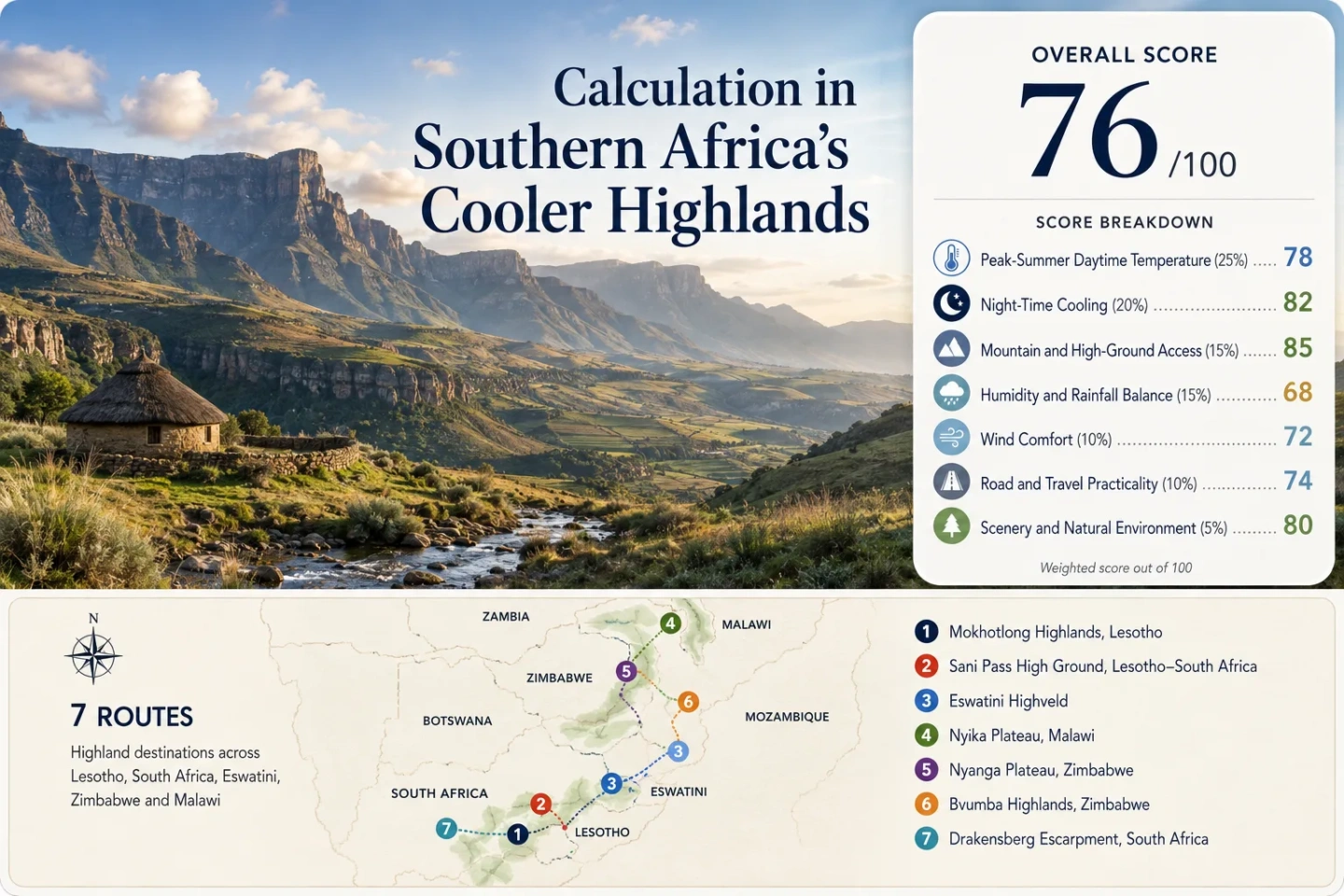
Southern Africa’s Cooler Highlands
Southern Africa’s strongest relief from lowland heat is often found by gaining elevation rather than simply moving south. The Maloti–Drakensberg, Lesotho Highlands, Eswatini Highveld, Zimbabwe Eastern Highlands and Malawi’s Nyika Plateau create several different highland climates: exposed alpine plateaus, mist-covered escarpments, forested uplands and elevated towns. January and February remain the regional summer reference months, but altitude can sharply change daytime heat, night temperatures, rainfall, wind and road conditions over short distances.
Thabana Ntlenyana in Lesotho marks the upper end of the Maloti–Drakensberg high country.
The western Highveld rises far above the warmer Lowveld and carries a more temperate, wetter climate.
Mount Nyangani anchors the northern Eastern Highlands above the Nyanga plateau.
Chelinda–Nyika demonstrates how high elevation can override much of the heat expected at a tropical latitude.
These months bring the strongest comparison between highland cooling and surrounding summer heat, but also more rain and thunderstorms in many uplands.
The Escarpment-and-Plateau Spine Behind the Cooler Air
Southern Africa does not contain one continuous cool mountain climate. Its elevated terrain forms a chain of related but contrasting systems. South Africa’s interior plateau sits well above sea level, the Great Escarpment rises sharply along its eastern edge, and the Maloti–Drakensberg reaches into the very high terrain of Lesotho. Farther north-east, Eswatini compresses a steep Highveld-to-Lowveld transition into a small country, while Zimbabwe’s Eastern Highlands rise along the Mozambique border. Nyika continues the high-plateau pattern farther north in Malawi.
Elevation changes the thermal starting point. Air expanding at lower pressure cools as it rises, so an elevated town or plateau usually begins summer with an advantage over nearby lowlands. The effect is not a fixed number of degrees per 1,000 metres at every place and hour. Cloud, humidity, wind, slope exposure and the source of the air mass can alter the actual difference.
The elevation of the overnight base is often more useful than the height of the nearest summit. Sleeping at roughly 2,200 metres around Mokhotlong is a different climate decision from staying much lower and viewing a 3,000-metre ridge in the distance. The same distinction applies around Nyanga, Bvumba and the Drakensberg: summit height describes the landscape, while lodging elevation helps determine the temperature experienced through the evening and early morning.
Eight Highland Zones With Different Cooling Patterns
| Highland zone | Representative elevation | Summer cooling pattern | Night character | Main weather trade-off |
|---|---|---|---|---|
| Mokhotlong Highlands, Lesotho | About 2,200 m at the town base | Very high continental plateau | Strong cooling after sunset | Summer thunderstorms and rapid mountain-weather changes |
| Sani Pass High Ground, Lesotho–South Africa | About 2,870 m near the pass summit | High-altitude exposure and wind | Cold relative to lower Drakensberg approaches | Cloud, storms and demanding road conditions |
| Mbabane Highveld, Eswatini | About 1,200 m | Moderate-altitude urban highland | Milder than the eastern Lowveld | Summer humidity, rain and cloud |
| Bulembu Highlands, Eswatini | About 1,300 m | Mountain-and-forest cooling | Cooler elevated nights | Mist and wet-season variability |
| Nyanga, Zimbabwe | About 1,680 m | Open high plateau and mountain air | Strong dry-season cooling; milder summer nights | Summer rain and exposed upland weather |
| Bvumba Highlands, Zimbabwe | Roughly 1,500–1,800 m across the higher zone | Forest shade, mist and cloud | Less extreme than open high plateaus | Fog, damp surfaces and reduced visibility |
| Chimanimani Highlands, Zimbabwe | About 1,500 m at the settlement, higher in the massif | Large relief between mountain slopes and lower valleys | Cooling strengthens away from lower terrain | Mountain storms and terrain-dependent conditions |
| Chelinda–Nyika Plateau, Malawi | 2,296 m at the meteorological station | High plateau cooling at tropical latitude | Cool nights and notably cold dry-season mornings | Rain, mist and remote highland access |
Elevation figures describe representative bases or highland reference points, not an entire mountain system. Conditions can change sharply between a valley floor, an exposed pass and a lodge several hundred metres higher.
Maloti–Drakensberg Has Two Different Highland Personalities
The Maloti–Drakensberg contains the region’s strongest combination of high lodging elevations, exposed passes and terrain above 3,000 metres. Lesotho is unusual because even its lower inhabited areas begin at elevations that would count as mountain country elsewhere. A trip does not have to reach a summit for altitude to influence the whole daily temperature cycle.
The Eastern Escarpment
Moist air approaching the Drakensberg from the east is forced upward. Cooling during that ascent encourages cloud, summer showers and thunderstorms on the exposed slopes. Cloud can reduce direct solar heating, while wet air and reduced visibility can make a seemingly mild mountain day feel very different from a dry plateau afternoon.
The trade-off is weather volatility. Higher ground may deliver lower temperatures while simultaneously increasing exposure to cloud, wind and rapidly developing storms.
The Lesotho Side
Behind the main escarpment, broad high plateaus and valleys can be drier and more exposed. Clearer conditions increase daytime solar heating, yet open high terrain can lose heat quickly after sunset. A sunny afternoon therefore does not reliably describe the overnight experience.
Day–night temperature range matters more here than a single afternoon maximum. High-elevation accommodation can require warm evening layers even when the daytime sun feels strong.
Eswatini Compresses a Highland-to-Lowveld Climate Shift Into a Short Distance
Eswatini’s western Highveld generally sits between about 910 and 1,830 metres, then the country steps down through the Middleveld toward the much warmer eastern Lowveld. That west-to-east drop makes Eswatini one of the clearest places to see why highland cooling does not require alpine elevation.
Mbabane and the western uplands combine elevation with a wetter, more temperate climate. Around Bulembu and the north-western mountains, forest cover, frequent cloud and higher terrain can further reduce daytime heat load. The result differs from Lesotho. Eswatini’s Highveld is generally lower, greener and more humid rather than starkly alpine.
Humidity changes the experience. A cloudy 24°C afternoon in the Highveld can feel less exposed than the same air temperature on an open plateau, but damp air may reduce the sharp evening cooling found in drier continental settings. Summer thunderstorms also matter more to day planning than a simple high-versus-low temperature comparison suggests.
Nyanga, Bvumba and Chimanimani Do Not Share the Same Kind of Coolness
Zimbabwe’s Eastern Highlands are often treated as one climate zone even though their terrain produces several different highland experiences. The northern Nyanga plateau, the forested Bvumba Mountains and the more rugged Chimanimani massif each alter heat in a different way.
Nyanga: Open Plateau Cooling
Nyanga sits high enough for elevation to shape both daytime and night-time temperatures. Open grassland and exposed slopes allow strong solar heating in clear weather, but the same exposure can support rapid cooling once the sun drops. Mount Nyangani rises to 2,592 metres, while most accommodation remains lower than the summit.
Bvumba: Forest and Mist
Bvumba adds dense vegetation, cloud and mist to its elevation advantage. Shade lowers direct radiant heat, while fog can keep afternoons muted compared with exposed high plateaus. The compromise is moisture: roads, walking surfaces and visibility can deteriorate without temperatures becoming especially low.
Chimanimani: Relief Matters
Chimanimani’s cooling effect depends strongly on where a stay sits within the terrain. Higher ridges and elevated bases can be markedly milder than lower valleys nearby. Moving only a modest horizontal distance can therefore produce a large vertical change and a noticeably different afternoon.
Nyika Shows How Altitude Can Override Tropical Latitude
Nyika Plateau provides the clearest northern contrast in the regional highland belt. Malawi lies much closer to the equator than Lesotho or South Africa, yet the Chelinda–Nyika meteorological station stands at 2,296 metres. Much of the plateau therefore operates in a temperature regime very different from nearby tropical lowlands.
The comparison exposes an important rule: latitude sets the broad climate; elevation can rewrite it locally. A high plateau near 10° south can produce cool nights and cold dry-season mornings even though lower terrain at the same latitude is warm.
Nyika is also more remote than an elevated capital such as Mbabane. The cooling value is therefore accompanied by a larger access commitment. Rain and mist can affect highland roads during the wet season, while the drier winter period can bring much colder mornings than a visitor choosing the plateau purely for heat relief might expect.
January Heat Relief and July Cold Belong to the Same Highlands
Northern Hemisphere season labels are particularly misleading in this region. January and February are Southern African summer months. June through August are winter. A location described as a mild highland escape in January can become a frost, ice or snow environment in July.
| Period | Maloti–Drakensberg | Eswatini Highveld | Zimbabwe Eastern Highlands | Nyika Plateau |
|---|---|---|---|---|
| January–February | Milder high-altitude days, cool nights, frequent summer storms | Warm-to-mild Highveld conditions with higher humidity and rain | Green, wet highlands with cloud and afternoon storm potential | Wet-season plateau with rain, cloud and mild high-elevation temperatures |
| April–May | Cooling quickly as rainfall decreases | Milder transition into the dry season | Less humid transition with colder nights developing | Dryer conditions begin and nights become colder |
| June–August | Cold; frost, ice and snow are possible on high ground | Cooler and generally drier | Dry-season sunshine with cold nights and local frost | Dry highland weather with cold mornings |
| September–October | Fast warming with large day–night ranges | Warming before the main wet season strengthens | Dry-to-wet transition and increasing afternoon convection | Warming ahead of heavier summer rainfall |
Winter highland travel is a different category from summer heat relief. The highest Lesotho and Drakensberg roads can encounter freezing temperatures, snow and ice. A destination being cooler in January does not imply gentle conditions throughout the year.
Four Different Forms of Highland Cooling
Alpine Exposure
Maloti–Drakensberg and upper Lesotho
Very high elevation, exposed terrain, strong night cooling and the region’s clearest winter snow risk. Summer sun can still feel intense despite low air temperatures.
Plateau Cooling
Nyanga and Nyika
Broad elevated surfaces produce milder daytime conditions and pronounced cooling after sunset. Open grassland can allow stronger solar heating than forested uplands.
Mistbelt Cooling
Bvumba and parts of western Eswatini
Elevation works together with forest, low cloud and mist. Daytime radiant heat may be reduced, while humidity and wet surfaces become larger planning considerations.
Elevated Town Cooling
Mbabane and similar highland bases
Moderate altitude provides relief without requiring a remote alpine road. The cooling effect is less extreme, but accommodation, services and everyday access are easier to combine.
A Mild Afternoon Can Still End With a Cold Highland Night
Highland comfort cannot be judged from maximum temperature alone. Open elevated land can warm quickly in direct sunshine and then lose heat rapidly after sunset. The difference is strongest where dry air, clear skies and exposed terrain allow efficient night-time heat loss.
Lower and Warmer Terrain
Lowland areas often retain more heat into the evening. A hot afternoon can be followed by a warm night, especially where humidity is high. The lack of overnight relief can matter as much as the daytime maximum.
High Plateau and Mountain Bases
High terrain can move from strong afternoon sunshine to a much cooler evening in only a few hours. Lesotho’s open plateaus, Nyanga’s exposed uplands and Nyika’s elevated grasslands display this pattern more clearly than humid mistbelt environments.
The practical distinction is simple: a destination with a comfortable daytime average is not automatically a warm-evening destination. Accommodation elevation, exposure and overnight minimums deserve separate attention.
Why Elevation Alone Cannot Predict the Cooler Stay
Accommodation Elevation
A 2,600-metre peak does little to cool a room located far down the valley. The altitude of the town, lodge or campsite is the more useful planning figure for overnight comfort.
Cold-Air Pooling
Calm, clear nights can allow dense cold air to settle into enclosed valleys. A valley floor can occasionally become colder before sunrise than a slightly higher slope nearby.
Slope and Sun Exposure
Sun-facing open slopes absorb more radiation than shaded forest or cloud-covered terrain. Two places at similar elevation can therefore produce noticeably different afternoon conditions.
Wind Exposure
Passes and plateau edges are often more exposed than sheltered towns. Moving air can reduce perceived warmth, but it also makes cool or cold conditions harsher when temperatures fall.
Cloud and Mist
Bvumba and parts of Eswatini can receive enough low cloud to reduce daytime solar heating. The same cloud can limit overnight radiative cooling, narrowing the daily temperature range.
Dry Plateau Air
Open Lesotho and other continental highlands can produce sharper day–night swings. Strong midday sun and a cold late evening can occur on the same day without contradiction.
Snow, Frost, Fog and Thunderstorms Belong to Different Highland Settings
| Highland environment | Weather issue to separate from temperature | Why it matters |
|---|---|---|
| Upper Lesotho and high Drakensberg | Snow, ice, frost and rapid mountain changes | Winter roads can move from ordinary highland driving to cold-weather travel conditions. |
| Nyanga and exposed Zimbabwe uplands | Cold mornings, summer convection and local frost in the dry season | Afternoon sunshine does not represent pre-dawn temperatures. |
| Bvumba mistbelt | Fog, wet roads and reduced visibility | Moderate temperatures can coexist with difficult visibility. |
| Eswatini Highveld | Summer rain, humidity and thunderstorms | Higher terrain is milder than the Lowveld but not necessarily dry. |
| Nyika Plateau | Mist, wet-season roads and cold dry-season mornings | Tropical latitude does not prevent high-altitude cold. |
Cool Air Does Not Mean Weak Highland Sun
High-altitude air can feel cool while direct sunshine remains strong. This contrast is especially noticeable on open Lesotho, Drakensberg, Nyanga and Nyika terrain where shade is limited. A cool breeze can mask how much solar radiation is reaching exposed skin, and strong sunshine can make an otherwise mild afternoon feel much warmer on a bare slope.
Forest and mistbelt environments behave differently. Bvumba and parts of western Eswatini can reduce direct solar load through tree cover and cloud, but greater humidity changes how heat is felt. Temperature, solar exposure and humidity therefore need to be treated as separate parts of the highland climate rather than folded into one idea of “cool weather.”
Highland Cooling Is Relative, Not Heat-Proof
Elevation lowers typical temperatures compared with surrounding lowlands, but it does not place a fixed ceiling on summer heat. Elevated towns can still experience unusually hot afternoons during broad regional heat events. Lower highlands such as the Eswatini Highveld generally have less thermal protection than terrain above 2,000 metres, while exposed plateaus can become surprisingly warm under clear, calm sunshine.
This makes the lowland-to-highland difference more useful than assuming that every place labelled “highland” is cool. A 1,200-metre town may provide meaningful relief from a nearby hot valley without producing mountain-cold conditions. A 2,300-metre plateau may offer much stronger cooling but bring colder nights, more weather exposure and harder access.
Where the Highland Difference Is Most Noticeable
Lowveld to Highveld
Eswatini provides the clearest short-distance elevation contrast. Moving west from the warmer Lowveld toward Mbabane, Malolotja and Bulembu adds altitude, rainfall and a more temperate highland character without requiring extreme mountain elevation.
An Entire Country Starting High
Lesotho behaves differently because the national terrain is already elevated. The question is often not whether to leave sea-level heat behind, but how much farther into the 2,000–3,000-metre high country to go and how much exposure to mountain weather is acceptable.
Tropical Latitude to High Plateau
Nyika creates the strongest latitude–altitude contrast. Its position in tropical southern Africa suggests warmth, while terrain above 2,000 metres produces a highland climate that can include cool nights and cold winter mornings.